
MCA Debt and the Oct 15 Tax Deadline: What to Do

The Oct 15 extended tax deadline collides with daily MCA debits every fall. Here's how to handle both without your business running out of cash.
The Deadline That Sneaks Up on Stacked Business Owners

October 15 is not just another date on the calendar. It’s the final deadline for business owners who filed a tax extension back in the spring, which means it’s the day a full year of profit and loss finally has to be reconciled with the IRS — in dollars, right now. If your business is current on its books but stretched thin on cash because of merchant cash advance debt, that reconciliation can land like a gut punch.
Here’s the collision nobody warns you about: your MCA funder is debiting your business bank account every single morning or every week, rain or shine, whether you had a good month or a brutal one. Meanwhile the IRS wants a lump-sum payment, or at minimum a credible plan, by October 15. Two creditors, two very different collection styles, and one bank account that has to somehow cover both.
If this is the position you’re in right now, you are far from alone. Owners who took on a merchant cash advance — or three, or five — to bridge an earlier cash gap often discover that the daily payment burden quietly consumed the reserve they should have been setting aside for taxes all year. The good news is that this is a solvable problem, and it doesn’t require choosing between paying the IRS and keeping your doors open. It just requires understanding your real options before the deadline forces a decision for you.
Why MCA Debt and Tax Season Fight for the Same Dollars

A merchant cash advance isn’t a loan in the legal sense — it’s a purchase of your future receivables, repaid through a factor rate rather than an interest rate. Where a loan might charge 10% APR, an MCA with a 1.35 factor rate on a $100,000 advance means you’re repaying $135,000 total, typically collected through daily or weekly ACH debits pulled directly from your business checking account. There’s no monthly due date to plan around — the money leaves before you’ve even decided how to allocate it.
That structure is exactly why MCA debt and tax obligations compete so directly. A business loan payment is fixed and predictable; you build it into a monthly budget. An MCA debit is relentless and, when you’ve stacked multiple advances, it can eat 15%, 20%, even 30% of daily revenue before you’ve paid rent, payroll, or a single supplier invoice — let alone set aside a tax reserve. The Federal Reserve’s Small Business Credit Survey has repeatedly found that businesses relying on high-cost, short-term financing like MCAs report cash flow as their top challenge — and tax season is where that challenge comes to a head.
If you’ve extended past the original filing date, the IRS still expects any tax owed to have been paid by the original due date, with the extension only covering the paperwork. That means penalties and interest may already be accruing quietly in the background, on top of what your MCA funders are pulling daily.
The Math That Catches Owners Off Guard
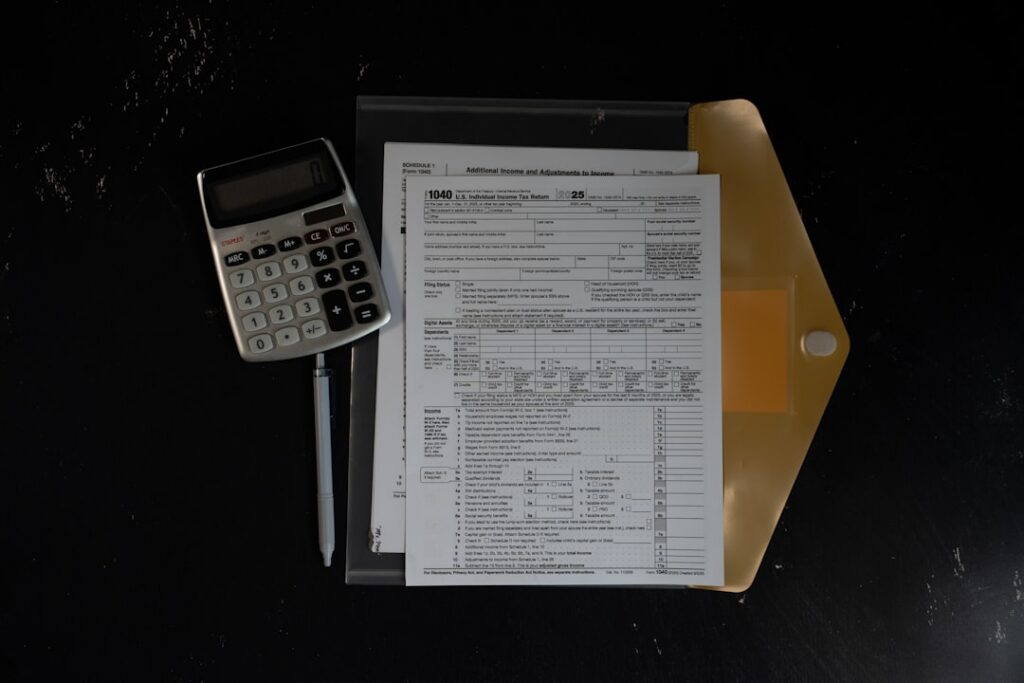
Let’s put real numbers on it. Say a contracting business owes $42,000 in taxes on October 15 and is also carrying two stacked MCAs with combined daily debits of $1,100. That’s roughly $23,000 a month just servicing MCA debt — before the owner has even looked at the tax bill. Add a $42,000 lump-sum obligation on top of that, and most businesses simply don’t have the liquidity sitting in the account to cover it.
This is the exact scenario that pushes owners toward decisions they later regret: taking out a sixth MCA to cover the tax bill, draining a 401(k), or maxing out a personal credit card tied to a personal guarantee. Each of those moves solves the October problem and creates a bigger one in November. The U.S. Small Business Administration is blunt about it: tax obligations don’t disappear because cash is tight, and the IRS has collection tools — including liens — that move faster than most business owners expect.
The good news is that the math also works in the other direction. When stacked MCA debt gets restructured — through a negotiated resolution that reduces the total balance and replaces five daily debits with one manageable structured plan — that freed-up cash flow is often exactly what’s needed to make the October 15 payment without a scramble.
The IRS Doesn't Negotiate the Way Your MCA Funder Does

One thing every stacked business owner should understand going into this deadline: the IRS and your MCA funders are playing by completely different rulebooks. The IRS has formal payment plans, and for many small businesses, an installment agreement is available without the drama of a lawsuit — details are laid out directly on IRS.gov. Payroll tax deposits (941 obligations) are treated as priority debt precisely because they involve money withheld from employees, so those get triaged first if cash is genuinely short.
MCA funders, by contrast, generally don’t offer anything resembling a standardized payment plan. Miss a debit and depending on your contract, you may trigger a reconciliation clause dispute, a cross-default on other advances, or in states where it’s still enforceable, a fast track toward a confession of judgment. The New York Attorney General’s office has documented how aggressively COJs were historically used against out-of-state small businesses before New York banned their use for that purpose in 2019 — a reminder of how one-sided MCA collection leverage can be compared to a government tax authority that, frankly, has seen this exact situation thousands of times before.
That asymmetry is precisely why the smart move, when cash is stretched across both obligations, is to address the MCA side proactively rather than let it default on autopilot while you focus every dollar on the IRS.
What a Negotiated Resolution Actually Buys You Before the Deadline

This is where the picture gets a lot more hopeful. A negotiated resolution with your MCA funders — whether that’s a lump-sum settlement at a reduced balance or a structured plan that stretches payments out and lowers the daily draw — directly frees up the cash flow you need to handle the IRS deadline without panic-borrowing. We’ve seen six-figure stacked MCA balances resolved for 70%, 80%, even 90% below the original amount in past settlements, once funders understand a lump-sum payoff now is worth more to them than years of collection risk. Results vary and are not guaranteed, but the pattern holds often enough that it’s worth exploring before assuming there’s no way out.
A hardship request is often the opening move — a direct conversation with the funder laying out the business’s real financial position and proposing terms it can actually sustain. From there, options branch out: a structured plan that converts daily debits into a predictable weekly or monthly payment, a lump-sum settlement funded by a short pause in collections, or in more severe stacking situations, Subchapter V of Chapter 11, a streamlined bankruptcy process built specifically for small businesses. The U.S. Courts website outlines how Subchapter V was designed to let owners keep operating while restructuring debt on a faster, cheaper timeline than traditional Chapter 11.
None of these paths require taking on another advance to pay the last one — which is the trap so many stacked owners fall into every October.
A Composite Case: Restructuring Before the Deadline Hit

Consider a composite scenario built from patterns seen across many small businesses: a landscaping company entering September with three MCA balances totaling $118,000 and a projected $31,000 tax bill due October 15. Daily debits alone were consuming close to $1,400 a day — nearly $30,000 a month — leaving almost nothing for the tax reserve the owner had intended to build all year.
Through a negotiated settlement process, the combined $118,000 across three funders was resolved for roughly $34,000 — a 71% reduction — paid as a lump sum funded by a short-term pause in collections while terms were finalized. That single move eliminated the daily debits entirely and freed up enough monthly cash flow for the owner to set up an IRS installment agreement for the tax balance without missing payroll. Every situation is different, and a result like this isn’t guaranteed — but it illustrates exactly why addressing the MCA side first often makes the tax side manageable, rather than the other way around.
What to Do Before October 15 Arrives

If you’re staring down both a tax deadline and daily MCA debits right now, the worst move is doing nothing and hoping next month is better. Start by getting an honest picture of exactly what’s owed on both sides — total MCA balances, current daily debit amounts, and the actual tax liability, including any 941 payroll deposits, which carry their own priority status with the IRS. From there, a conversation about restructuring the MCA debt can often unlock the breathing room needed to handle the tax obligation on reasonable terms, whether that’s a full IRS installment plan or a one-time payment.
This information addresses commercial business debt and is not consumer debt advice, and creditors may not always agree to proposed terms — every situation is different, and results vary and are not guaranteed. But business owners who get ahead of this collision, rather than letting the calendar decide for them, consistently end up with more options and less stress. Before October 15 arrives, it’s worth a conversation with an MCA Relief Specialist or a business attorney to map out what’s realistic for your specific numbers. One phone call now can be the difference between a manageable plan and a scramble you didn’t have to have.
Photo credits: Featured image by Vitaly Gariev on Unsplash; Section 1 by Vitaly Gariev on Unsplash; Section 2 by Tech Daily on Unsplash; Section 3 by Kelly Sikkema on Unsplash; Section 4 by Vitaly Gariev on Unsplash; Section 5 by Amina Atar on Unsplash; Section 6 by stable pattern on Unsplash; Section 7 by Vitaly Gariev on Unsplash.